Liquid Cooling
The Evolution of Data Centers: Power, Cooling, and Sustainability Toward 2030
Year: 2025
By 2030, physical infrastructure expansion will be driven by innovation in power generation, distribution, and thermal management.
Physical Growth and Unprecedented Power Levels
According to Omdia’s Cloud and Data Center Analysis (2025), IT infrastructure will remain the largest cost item in data centers. The constant demand for greater computing capacity requires continuous investment in new hardware technologies and energy management systems
By 2030, physical infrastructure expansion will be driven by innovation in power generation, distribution, and thermal management.
Rack-scale AI computing designs are pushing rack power density to unprecedented levels, making traditional power delivery and cooling technologies obsolete.
The growing demand for compute and memory resources is transforming rack-scale system design (data constantly updated):
- 120 kW in 2025
- 240 kW in 2026
- up to 600 kW in 2027
Cooling Becomes a Strategic Priority
Cooling is no longer just a technical necessity — it is a strategic priority. Maintaining stable temperatures is essential to ensure operational continuity and data security.
Liquid cooling innovation will accelerate rapidly alongside the large-scale rollout of new data centers.By 2030, the Data Center's electrical distribution will be redesigned with an increase in voltage from the current 400 volts to 800-volt systems.
According to Omdia's Cloud and Data Center analysis (2025), unlike traditional air conditioning systems, AI cooling systems will be able to use intelligent algorithms to dynamically adjust cooling strategies based on real-time data — including workload, ambient temperature, and other operating factors.This approach not only enhances cooling efficiency but also significantly reduces energy consumption.
Direct-to-Chip: The Reference Technology
In the short term, Direct-to-Chip Liquid Cooling will remain the leading liquid cooling solution.
This technology removes heat directly at the chip level by placing a cold plate on the chip and circulating liquid through it to absorb heat.It can operate or in single-phase mode or in two-phase mode.
Another method, Immersion Liquid Cooling, dissipates heat at the server level, immersing the entire server in a container filled with a dielectric coolant. It can also be single- or two-phase, depending on the heat removal process.
Liquid cooling — particularly Direct-to-Chip — is expected to become dominant, thanks to:
- superior thermal conductivity,
- support for high-density computing environments,
- cost-effectiveness.
However, liquid cooling alone cannot be the final solution.
Hybrid Solutions: Combining Air and Liquid Cooling
Liquid cooling systems offer greater thermal efficiency and lower energy consumption, even with increasingly powerful microprocessors.Yet, they are not complete solutions: about 10–20% of the heat is still released into the air.
For this reason, it is necessary to resort to hybrid solutions that combine coordinated air and liquid cooling for servers in a Direct-to-Chip version.
The goal is to leverage the synergy between air and water to minimize inefficiencies and ensure maximum operational continuity in data centers.
Technologies for DC Thermal Efficiency
Coolant Distribution Units (CDUs) are fundamental components in liquid cooling systems that enable efficient distribution and circulation of the coolant, ensuring optimal component temperatures.
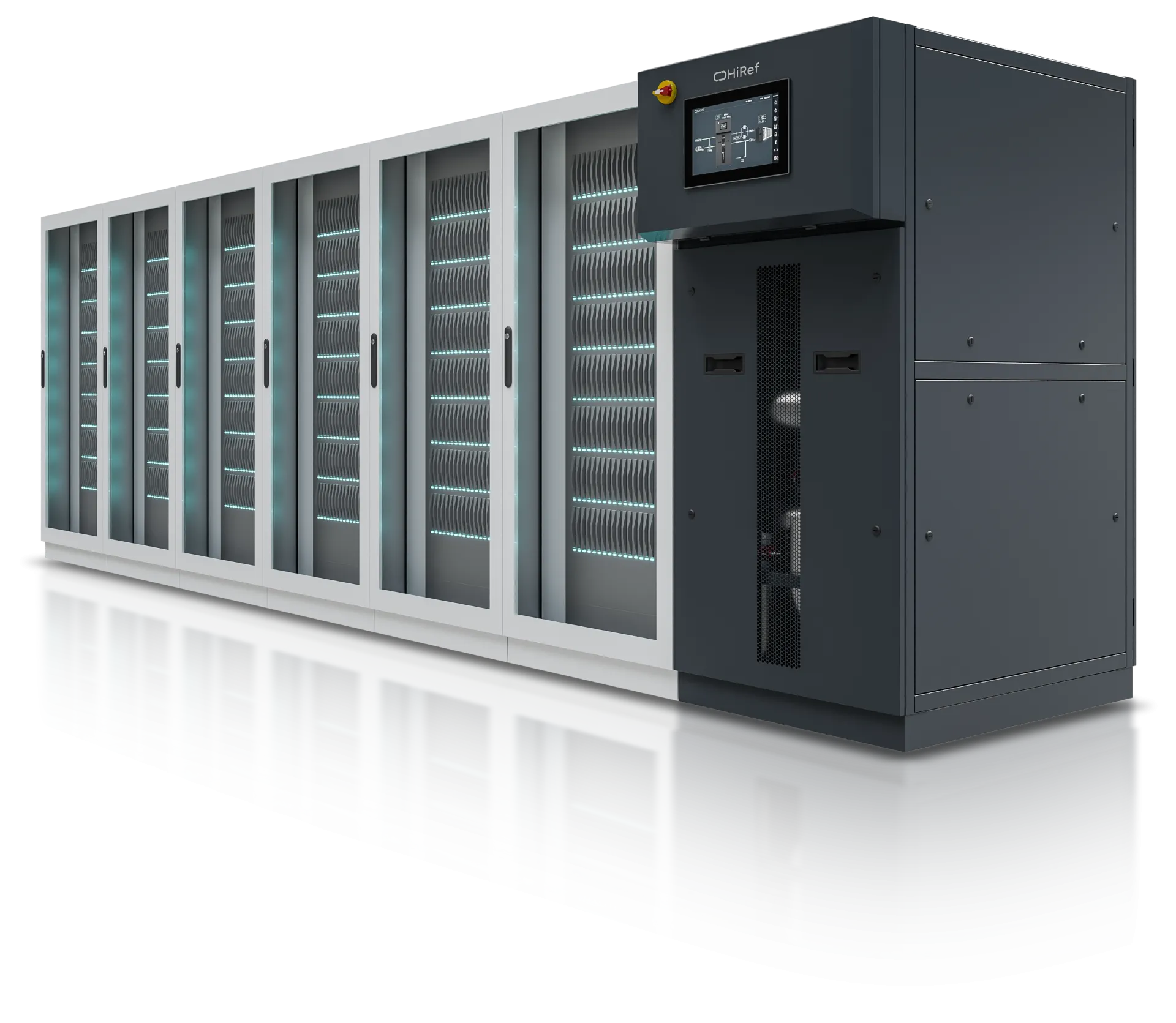
At the same time, HiRef develops advanced solutions for Data Centers:
- Rear Door Units: active or passive air conditioning systems that dissipate heat directly at the back of server racks;
- Dry Coolers: outdoor units that can be combined with water-cooled indoor systems to make the most of free cooling and are designed to work with water-glycol mixtures up to 60%.
Another key element is HiNode, a management and monitoring system that connects to and supervises all cooling system components, ensuring integrated and efficient operation.
Heat recovery systems — which convert waste heat from data centers into usable energy for building heating — will become increasingly widespread.
I sistemi di recupero del calore — che trasformano l’energia termica di scarto dei data center in fonte di riscaldamento per gli edifici — diventeranno sempre più diffusi.
Guarda il video del nostro Energy Loop District: